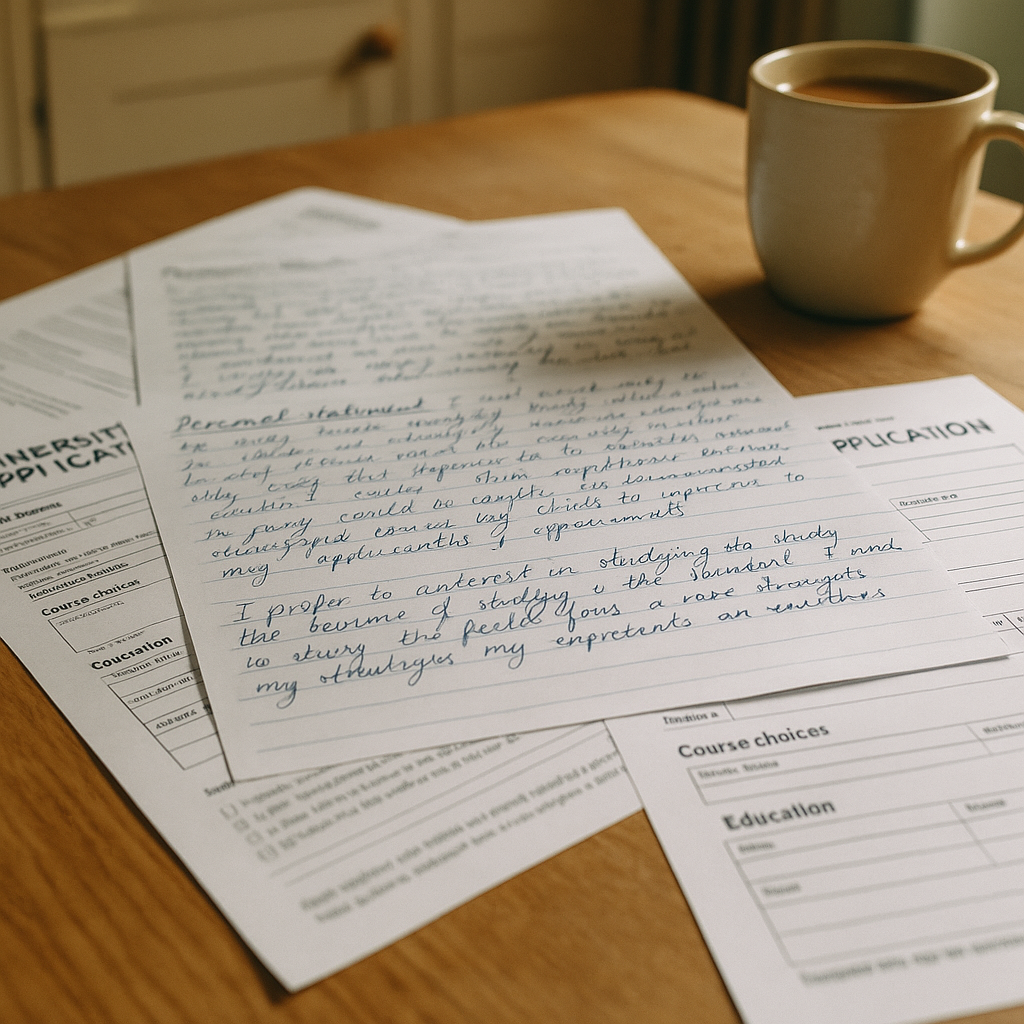
There is something quietly remarkable about a teenager sitting at a kitchen table, trying to condense their entire personality into 4,000 characters, and accidentally producing the most talked-about piece of writing in the country. Yet it happens. Every application cycle, a handful of sixth-formers and undergraduates manage to turn the deeply unglamorous business of applying to university into a genuine cultural moment. A UCAS personal statement goes viral in the UK, Twitter erupts, broadsheets run think-pieces, and suddenly a seventeen-year-old from Doncaster or a final-year student in Edinburgh is doing radio interviews before their conditional offer has even arrived.
What drives these moments? And more importantly, what actually happens afterwards? Because the gap between a viral tweet and a transformed future is wider than most people assume.

The Personal Statement That Broke the Internet (Almost)
The most celebrated recent example in British culture is almost certainly the “bananas” personal statement saga. Back when personal statement openings circulated on social media, a supposed excerpt about a student opening with an extended metaphor comparing their love of economics to the supply-and-demand dynamics of fruit became a meme that genuinely would not die. UCAS eventually had to issue guidance about it. Whether the original statement was real or a collective confabulation hardly mattered by that point; it had taken on a life entirely its own.
But beyond the apocryphal classics, real students have genuinely found themselves in the national spotlight because of their application materials. In 2023, a student from Birmingham made headlines after her personal statement for a nursing degree at the University of Warwick was shared by an admissions tutor (with her permission) as an example of exceptional writing about lived experience in the NHS. She had cared for a relative through a long illness and described it with unusual precision and emotional intelligence. The Guardian ran a feature. She received messages from nursing professionals across the country. She also, it should be said, got her place.
Gap Year Projects That Stopped the Scroll
If personal statements are one route to unexpected attention, gap year ventures are another entirely. The gap year, long associated with gap year clichés, has produced some genuinely extraordinary stories in recent years that have cut through national media.
A student from Hertfordshire spent twelve months cycling from Land’s End to John O’Groats, then continuing into Europe, raising funds for a mental health charity. That alone might not have made national news. What did was the journal he kept, posted in real time on a blog with deliberately plain, almost bureaucratic prose. The contrast between the epic journey and the deadpan writing voice caught the attention of a Radio 4 producer. He appeared on You and Yours, then on Woman’s Hour. The BBC piece remains one of the more unusual gap year profiles in recent memory.
Then there was the sixth-former from Fife who, rather than travelling anywhere, spent her gap year documenting every aspect of her small coastal town through a series of hand-painted illustrated maps. She sold prints locally, then nationally via Instagram, and was commissioned by a Dundee arts organisation before she had set foot in her first undergraduate lecture. Her story reached the Scottish press and then, briefly, the national arts pages. The attention came not from a single viral post but from the accumulating weight of a project done with real care over a long period of time.
Niche Dissertations That Found a Surprisingly Wide Audience
Undergraduate and postgraduate dissertations rarely escape the university library. Most gather digital dust in an institutional repository, read by precisely the three people who marked them. But occasionally, a thesis lands on a topic so unexpectedly relevant, or so specifically weird, that it escapes into the broader culture.
A student at the University of Leeds completed a dissertation examining the linguistic patterns of complaints posted to local council Facebook pages across West Yorkshire. The research itself was rigorous. But when a summary was posted by the university’s press office, it went genuinely viral in a way academic press releases almost never do. The combination of the subject matter (everyone relates to an aggrieved council post) and the dry academic framing was irresistible. The student appeared on local radio, was quoted in the BBC News website, and was approached by a data journalism team about further collaboration.
A final-year fashion student at Central Saint Martins made the national press after her graduate collection, inspired by the architectural patterns of brutalist council estates across London, was photographed at the degree show and shared widely online. She had written a 10,000-word accompanying dissertation connecting post-war housing policy to contemporary fashion aesthetics. Publishers noticed. A book proposal followed. Whether it comes to anything remains to be seen, but the attention was real and the opportunity genuine.
What Does the Attention Actually Do for You?
This is the part nobody really talks about honestly. When a UCAS personal statement goes viral, or a dissertation lands in the national press, the immediate experience is often disorienting rather than triumphant. Inboxes fill with messages from people who have strong opinions about the thing you made, most of them fine, some of them strange, a few of them outright odd. The attention has a short half-life. Within a fortnight, the cycle has moved on.
What tends to remain, though, is a tangible residue. The BBC radio clip that future employers can hear. The journalist who bookmarked your name. The university department that now uses your work as a case study. The network of people in your field who heard about you before you had any professional credentials at all. For young people at the very start of their working lives, that residue can matter considerably.
The students who seem to benefit most are those who were already doing something genuinely interesting before the attention arrived. The media moment amplifies what is already there; it cannot conjure substance from nothing. The cycling blogger from Hertfordshire was a good writer before Radio 4 called. The Fife cartographer had a real artistic practice before anyone shared her maps. That is the consistent pattern. Viral attention rewards those who have already done the work.
Could Your Application or Project Be Next?
UCAS processes around 700,000 applications each year, according to figures from UCAS itself. The vast majority pass through the system without attracting any attention beyond the admissions tutor reading them on a Tuesday afternoon. But the ones that do break through share a few characteristics worth noting.
They tend to be specific rather than general. A personal statement that opens with a precise memory, a particular moment, a named place, reads entirely differently to one that begins with a broad philosophical observation about the importance of the subject. They tend to be honest in a way that is slightly braver than comfortable. And they tend to be written by people who have actually done something, rather than people who have thought about doing something.
If you are a sixth-former currently staring at a blank UCAS form, or an undergraduate wondering whether your niche dissertation topic is too strange to be worth pursuing, the stories above suggest the opposite conclusion. Specificity is not a liability. The unusual angle is not a risk. The thing that makes you slightly embarrassed to admit might be exactly the thing that deserves its fifteen minutes.
Just write it well. And mean it.
Frequently Asked Questions
Has a UCAS personal statement really ever gone viral in the UK?
Yes, several real and rumoured personal statement excerpts have circulated widely on social media and been covered in national press. The most famous involve unusually creative or emotionally powerful openings that admissions tutors or students shared online, sometimes prompting UCAS to issue guidance on personal statement writing.
Can going viral actually help you get into university?
Viral attention alone does not influence UCAS decisions, which are made by individual universities based on academic and personal criteria. However, the underlying qualities that make a personal statement compelling enough to go viral, clarity, originality, genuine experience, are exactly what admissions tutors respond to.
What kinds of gap year projects tend to attract media attention?
Projects with a clear narrative arc, a strong visual or documentary element, and a local or community dimension tend to travel furthest. Cycling journeys, creative mapping projects, and charity fundraising ventures with an unusual twist have all made national press in recent years.
Are niche or unusual dissertation topics risky for your academic career?
Not inherently, as long as the research is methodologically sound and supervised properly. Several students who chose unconventional dissertation topics found that the originality attracted media and professional attention that opened doors they would not otherwise have accessed.
How long does the media attention typically last for student viral moments?
Most student viral moments peak within a week to a fortnight and then fade from public view. What tends to persist is the professional network built during that window, any recorded media appearances, and the institutional recognition from universities or organisations who encountered the work.