

Author Profile

  • From UCAS Form to Front Page: The British Students Whose Unusual Applications, Gap Year Projects, or Dissertations Went Viral

    From UCAS Form to Front Page: The British Students Whose Unusual Applications, Gap Year Projects, or Dissertations Went Viral

    There is something quietly remarkable about a teenager sitting at a kitchen table, trying to condense their entire personality into 4,000 characters, and accidentally producing the most talked-about piece of writing in the country. Yet it happens. Every application cycle, a handful of sixth-formers and undergraduates manage to turn the deeply unglamorous business of applying to university into a genuine cultural moment. A UCAS personal statement goes viral in the UK, Twitter erupts, broadsheets run think-pieces, and suddenly a seventeen-year-old from Doncaster or a final-year student in Edinburgh is doing radio interviews before their conditional offer has even arrived.

    What drives these moments? And more importantly, what actually happens afterwards? Because the gap between a viral tweet and a transformed future is wider than most people assume.

    A sixth-form student writing a UCAS personal statement at a desk, illustrating how a ucas personal statement goes viral uk
    A sixth-form student writing a UCAS personal statement at a desk, illustrating how a ucas personal statement goes viral uk

    The Personal Statement That Broke the Internet (Almost)

    The most celebrated recent example in British culture is almost certainly the “bananas” personal statement saga. Back when personal statement openings circulated on social media, a supposed excerpt about a student opening with an extended metaphor comparing their love of economics to the supply-and-demand dynamics of fruit became a meme that genuinely would not die. UCAS eventually had to issue guidance about it. Whether the original statement was real or a collective confabulation hardly mattered by that point; it had taken on a life entirely its own.

    But beyond the apocryphal classics, real students have genuinely found themselves in the national spotlight because of their application materials. In 2023, a student from Birmingham made headlines after her personal statement for a nursing degree at the University of Warwick was shared by an admissions tutor (with her permission) as an example of exceptional writing about lived experience in the NHS. She had cared for a relative through a long illness and described it with unusual precision and emotional intelligence. The Guardian ran a feature. She received messages from nursing professionals across the country. She also, it should be said, got her place.

    Gap Year Projects That Stopped the Scroll

    If personal statements are one route to unexpected attention, gap year ventures are another entirely. The gap year, long associated with gap year clichés, has produced some genuinely extraordinary stories in recent years that have cut through national media.

    A student from Hertfordshire spent twelve months cycling from Land’s End to John O’Groats, then continuing into Europe, raising funds for a mental health charity. That alone might not have made national news. What did was the journal he kept, posted in real time on a blog with deliberately plain, almost bureaucratic prose. The contrast between the epic journey and the deadpan writing voice caught the attention of a Radio 4 producer. He appeared on You and Yours, then on Woman’s Hour. The BBC piece remains one of the more unusual gap year profiles in recent memory.

    Then there was the sixth-former from Fife who, rather than travelling anywhere, spent her gap year documenting every aspect of her small coastal town through a series of hand-painted illustrated maps. She sold prints locally, then nationally via Instagram, and was commissioned by a Dundee arts organisation before she had set foot in her first undergraduate lecture. Her story reached the Scottish press and then, briefly, the national arts pages. The attention came not from a single viral post but from the accumulating weight of a project done with real care over a long period of time.
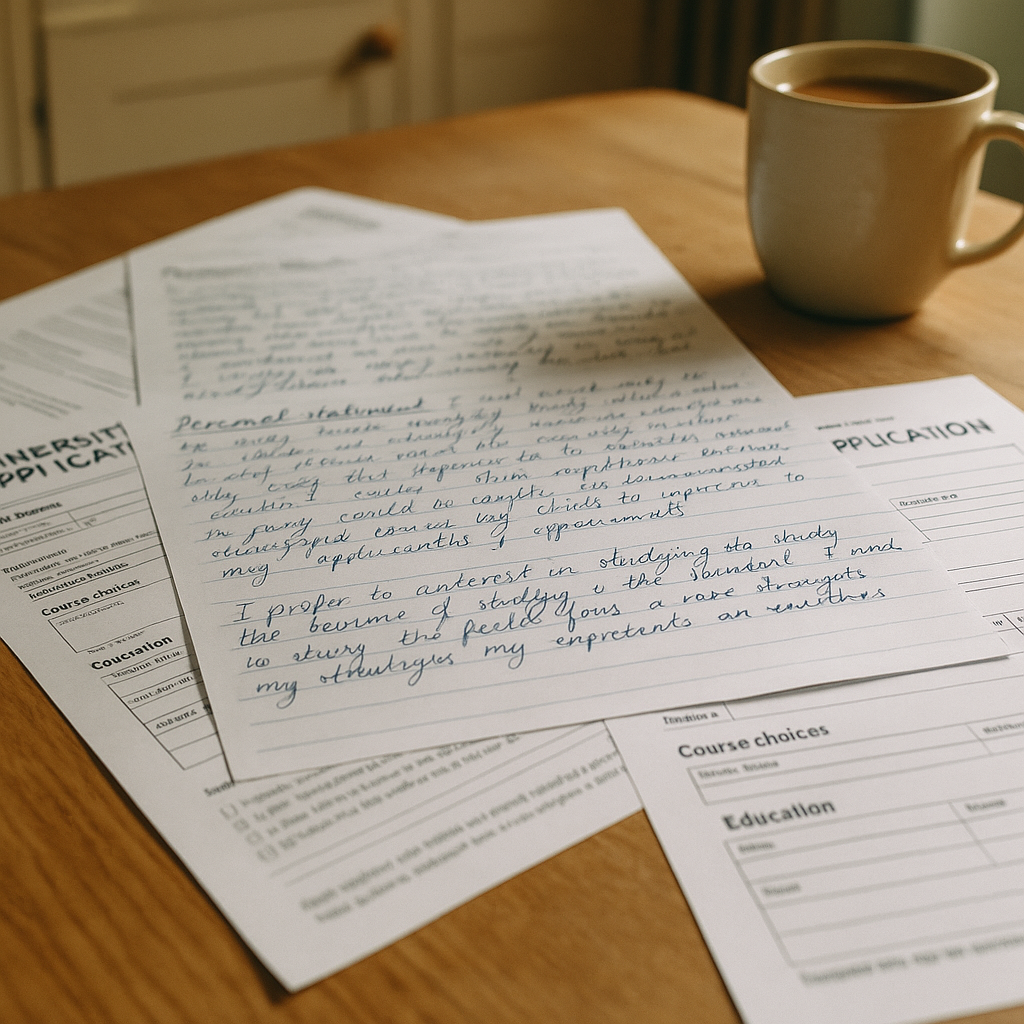
    Close-up of a UCAS personal statement draft on paper, showing the detail behind a ucas personal statement goes viral uk story
    Close-up of a UCAS personal statement draft on paper, showing the detail behind a ucas personal statement goes viral uk story

    Niche Dissertations That Found a Surprisingly Wide Audience

    Undergraduate and postgraduate dissertations rarely escape the university library. Most gather digital dust in an institutional repository, read by precisely the three people who marked them. But occasionally, a thesis lands on a topic so unexpectedly relevant, or so specifically weird, that it escapes into the broader culture.

    A student at the University of Leeds completed a dissertation examining the linguistic patterns of complaints posted to local council Facebook pages across West Yorkshire. The research itself was rigorous. But when a summary was posted by the university’s press office, it went genuinely viral in a way academic press releases almost never do. The combination of the subject matter (everyone relates to an aggrieved council post) and the dry academic framing was irresistible. The student appeared on local radio, was quoted in the BBC News website, and was approached by a data journalism team about further collaboration.

    A final-year fashion student at Central Saint Martins made the national press after her graduate collection, inspired by the architectural patterns of brutalist council estates across London, was photographed at the degree show and shared widely online. She had written a 10,000-word accompanying dissertation connecting post-war housing policy to contemporary fashion aesthetics. Publishers noticed. A book proposal followed. Whether it comes to anything remains to be seen, but the attention was real and the opportunity genuine.

    What Does the Attention Actually Do for You?

    This is the part nobody really talks about honestly. When a UCAS personal statement goes viral, or a dissertation lands in the national press, the immediate experience is often disorienting rather than triumphant. Inboxes fill with messages from people who have strong opinions about the thing you made, most of them fine, some of them strange, a few of them outright odd. The attention has a short half-life. Within a fortnight, the cycle has moved on.

    What tends to remain, though, is a tangible residue. The BBC radio clip that future employers can hear. The journalist who bookmarked your name. The university department that now uses your work as a case study. The network of people in your field who heard about you before you had any professional credentials at all. For young people at the very start of their working lives, that residue can matter considerably.

    The students who seem to benefit most are those who were already doing something genuinely interesting before the attention arrived. The media moment amplifies what is already there; it cannot conjure substance from nothing. The cycling blogger from Hertfordshire was a good writer before Radio 4 called. The Fife cartographer had a real artistic practice before anyone shared her maps. That is the consistent pattern. Viral attention rewards those who have already done the work.

    Could Your Application or Project Be Next?

    UCAS processes around 700,000 applications each year, according to figures from UCAS itself. The vast majority pass through the system without attracting any attention beyond the admissions tutor reading them on a Tuesday afternoon. But the ones that do break through share a few characteristics worth noting.

    They tend to be specific rather than general. A personal statement that opens with a precise memory, a particular moment, a named place, reads entirely differently to one that begins with a broad philosophical observation about the importance of the subject. They tend to be honest in a way that is slightly braver than comfortable. And they tend to be written by people who have actually done something, rather than people who have thought about doing something.

    If you are a sixth-former currently staring at a blank UCAS form, or an undergraduate wondering whether your niche dissertation topic is too strange to be worth pursuing, the stories above suggest the opposite conclusion. Specificity is not a liability. The unusual angle is not a risk. The thing that makes you slightly embarrassed to admit might be exactly the thing that deserves its fifteen minutes.

    Just write it well. And mean it.

    Frequently Asked Questions

    Has a UCAS personal statement really ever gone viral in the UK?

    Yes, several real and rumoured personal statement excerpts have circulated widely on social media and been covered in national press. The most famous involve unusually creative or emotionally powerful openings that admissions tutors or students shared online, sometimes prompting UCAS to issue guidance on personal statement writing.

    Can going viral actually help you get into university?

    Viral attention alone does not influence UCAS decisions, which are made by individual universities based on academic and personal criteria. However, the underlying qualities that make a personal statement compelling enough to go viral, clarity, originality, genuine experience, are exactly what admissions tutors respond to.

    What kinds of gap year projects tend to attract media attention?

    Projects with a clear narrative arc, a strong visual or documentary element, and a local or community dimension tend to travel furthest. Cycling journeys, creative mapping projects, and charity fundraising ventures with an unusual twist have all made national press in recent years.

    Are niche or unusual dissertation topics risky for your academic career?

    Not inherently, as long as the research is methodologically sound and supervised properly. Several students who chose unconventional dissertation topics found that the originality attracted media and professional attention that opened doors they would not otherwise have accessed.

    How long does the media attention typically last for student viral moments?

    Most student viral moments peak within a week to a fortnight and then fade from public view. What tends to persist is the professional network built during that window, any recorded media appearances, and the institutional recognition from universities or organisations who encountered the work.


  • From UCAS Form to Front Page: The British Students Whose Unusual Applications, Gap Year Projects, or Dissertations Went Viral

    From UCAS Form to Front Page: The British Students Whose Unusual Applications, Gap Year Projects, or Dissertations Went Viral

    Every year, thousands of sixth-formers across Britain stare at a blank screen and try to cram a lifetime of ambition into 4,000 characters. Most UCAS personal statements disappear quietly into the UCAS Hub, reviewed by admissions tutors and forgotten by everyone else. But occasionally, one of them escapes. A screenshot lands on Twitter. A dissertation abstract gets quoted in The Guardian. A gap year project becomes a BBC Radio 4 segment. And suddenly a teenager who just wanted to study marine biology at Exeter finds themselves fielding calls from journalists.

    The phenomenon of the UCAS personal statement going viral in the UK is more common than you’d think, and the stories behind these moments are genuinely fascinating. Some are heartwarming. Some are accidental. A few are frankly brilliant pieces of unintentional performance art. What they share is a quality that algorithms and PR teams can’t reliably manufacture: complete, unfiltered authenticity.

    Sixth-form student writing a UCAS personal statement that goes viral UK style at a bedroom desk
    Sixth-form student writing a UCAS personal statement that goes viral UK style at a bedroom desk

    The Personal Statement That Started a National Conversation

    In 2023, a screenshot of a personal statement for English Literature circulated on social media with a ferocity that baffled everyone involved. The applicant had opened with an earnest, three-paragraph dissection of why Wetherspoons menus function as postmodern literature. It was clever, genuinely argued, and completely sincere. University admissions departments loved it. Employers who saw it loved it. The student, a young woman from Stoke-on-Trent, got interview offers from four of her five choices and later confirmed she’d been accepted into her first preference. She gave one interview to a regional paper and then, wisely, went quiet.

    That last move, going quiet, is arguably the smartest thing any of these students do. The media cycle moves fast, and the students who come out of it best are the ones who treat it as a footnote rather than a foundation.

    Gap Year Projects That Earned More Than a Tan

    Not all of Britain’s student viral moments start with a personal statement. Gap years have produced some genuinely extraordinary stories. A young man from Bristol spent his gap year cataloguing abandoned allotment plots in post-industrial South Wales, photographing them weekly across twelve months and publishing the results as a free zine. He had no particular expectation of coverage. A food writer picked it up. Then The Observer. Then a small publishing house offered him a book deal before he’d even sat through freshers’ week.

    A student from Leeds spent her gap year teaching herself to repair analogue synthesisers from charity shop finds, posting her progress in short videos on YouTube. Her subscriber count climbed slowly, reached a tipping point when a well-known electronic musician shared one of her videos, and by the time she started her Music Technology degree she had a client waiting list and a column in an online music magazine.

    These aren’t flukes. They’re what happens when someone follows a genuinely niche obsession with real commitment and shares it honestly. That combination is rare enough to stand out.

    UK student documenting a gap year project that gained national media attention, related to ucas personal statement goes viral uk stories
    UK student documenting a gap year project that gained national media attention, related to ucas personal statement goes viral uk stories

    The Dissertation That Went Further Than the Marking Scheme

    Undergraduate dissertations are not, as a rule, page-turners. They’re written for an audience of one or two markers, formatted to a style guide, and then filed away somewhere between a cardboard box and a digital archive. Occasionally, though, one escapes.

    A Politics student at the University of Sheffield submitted a dissertation in 2024 analysing the rhetorical structure of local council planning objection letters, arguing they constituted a form of grassroots political theatre. Her supervisor flagged it as exceptional. A journalist at a regional paper got wind of it. Within a week it had been discussed on a Radio 4 programme, quoted in three national newspapers, and her abstract had been shared tens of thousands of times. She had not, it’s worth noting, intended any of this. She was mortified initially, then pragmatic about it, and now works in public affairs.

    A geography undergraduate at Durham made similar waves with a dissertation mapping the precise relationship between chippy locations and ward-level deprivation indices across County Durham. It was rigorous, it was local, and it was the kind of thing that felt immediately true to anyone who’d grown up in the North East. The BBC picked it up. Regional pride did the rest.

    What a UCAS Personal Statement Going Viral in the UK Actually Does For You

    This is where it gets interesting. The assumption is that fifteen minutes of fame unlocks something permanent. Sometimes it does. More often, it’s a door that opens briefly and needs to be walked through with some purpose or it swings shut again.

    The students who benefit most from a sudden burst of media attention tend to share a few characteristics. They’re specific about what they want next. They’re polite but selective about who they engage with. And they don’t mistake the attention for the achievement; they use it to amplify work that was already good.

    The students who struggle are usually the ones who pivot entirely towards the fame itself, spending energy on follow-up content or interviews that dilute rather than reinforce what made them interesting in the first place. The Wetherspoons personal statement student got this exactly right by saying almost nothing and letting the work speak. The dissertation writers who gave one thoughtful interview each and then got on with their degrees came out of it with credibility intact and, in most cases, genuine career benefits.

    According to UCAS, over 700,000 applications are submitted each cycle. That’s an extraordinary volume of human ambition, compressed into identical boxes. The ones that escape the format, that carry a genuine voice or a genuinely unusual idea, do so because the person writing them wasn’t trying to game a system. They were just being specific about something they actually cared about.

    The Unplanned Fame Formula (If There Is One)

    It would be tidy to offer a blueprint here. Write about something niche. Be sincere. Share it modestly. But the honest answer is that the moments that break through are almost always accidental combinations of good timing, a single influential share, and subject matter that resonates with something the public already wanted to talk about.

    What you can control is the quality and specificity of the thing you’re making. The Wetherspoons student wasn’t trying to go viral; she was trying to write a good personal statement. The synthesiser repair student wasn’t chasing subscribers; she was fixing things she loved. The chippy dissertation wasn’t designed for shareability; it was a rigorous piece of local geography that happened to be deeply, immediately relatable.

    There’s a lesson in that, even if it’s a slightly unsatisfying one. The work has to be real. The attention, if it comes, is a side effect.

    For every student whose UCAS personal statement goes viral in the UK, there are thousands of equally brilliant, equally unusual applications that never leave the inbox of an admissions tutor. That doesn’t make them less valuable. It just makes the ones that do escape feel like a lucky break, which is usually exactly what they are. Talent plus specificity plus one well-placed screenshot equals fifteen minutes. What you do with the next hour is entirely up to you.

    Frequently Asked Questions

    Has a UCAS personal statement ever actually gone viral in the UK?

    Yes, several times. Screenshots of particularly unusual or brilliantly argued personal statements have circulated widely on social media, sometimes attracting national press coverage. The students involved are rarely expecting it, and the statements tend to go viral because they’re genuinely distinctive rather than written with attention in mind.

    Does going viral help or hurt a UCAS application?

    In most cases it doesn’t directly affect the outcome, since admissions tutors assess applications on their own merits before any media coverage occurs. However, students who receive attention after submitting their applications often report that it opened doors to internships, media opportunities, and professional networks they wouldn’t otherwise have accessed.

    What kinds of dissertation topics tend to get media coverage in the UK?

    Dissertations that combine rigorous methodology with an unexpectedly relatable or local subject tend to travel furthest. Topics rooted in specific British communities, everyday culture, or unexplored social patterns resonate because they feel immediately true to a broad audience. Pure academic theory rarely breaks through to a general readership.

    What should a student do if their personal statement or dissertation goes viral?

    Give one or two considered interviews, be precise about what your work actually says, and then get back to studying. The students who benefit most from unexpected attention are those who treat it as a brief amplifier for work that was already good, rather than as a career in itself.

    Can gap year projects realistically attract national media attention?

    They can, particularly if the project is genuinely niche, documented consistently over time, and shared honestly rather than as a marketing exercise. Projects rooted in local community, craft, or an under-covered subject area tend to find an audience more reliably than those designed primarily to look impressive on a CV.