

There is something irresistible about a David and Goliath story, and few modern versions of it are quite as compelling as the sight of an ordinary British homeowner squaring up to a local council over a loft conversion, a garden wall, or a set of solar panels. What used to be a bureaucratic nightmare played out in dusty planning committee meeting rooms has become, in recent years, a reliable source of national news headlines and social media fire. The planning permission dispute UK viral pipeline is very much open for business, and it shows no sign of slowing down.
The cases vary wildly. There are the battles over listed building consent, where homeowners find themselves forbidden from replacing a rotting window frame with anything other than an exact replica. There are the neighbours who have reported each other to the council over a fence that sits six inches over the boundary, ending up on local news and then, somehow, on the front page of the Daily Mail. And there are the families who built their dream extension only to receive an enforcement notice two years later, forcing them to tear it down brick by brick. Each story arrives with its own cast of characters, its own absurdist detail, and its own peculiarly British emotional register: outrage, bewilderment, and a stubborn refusal to simply accept the decision.
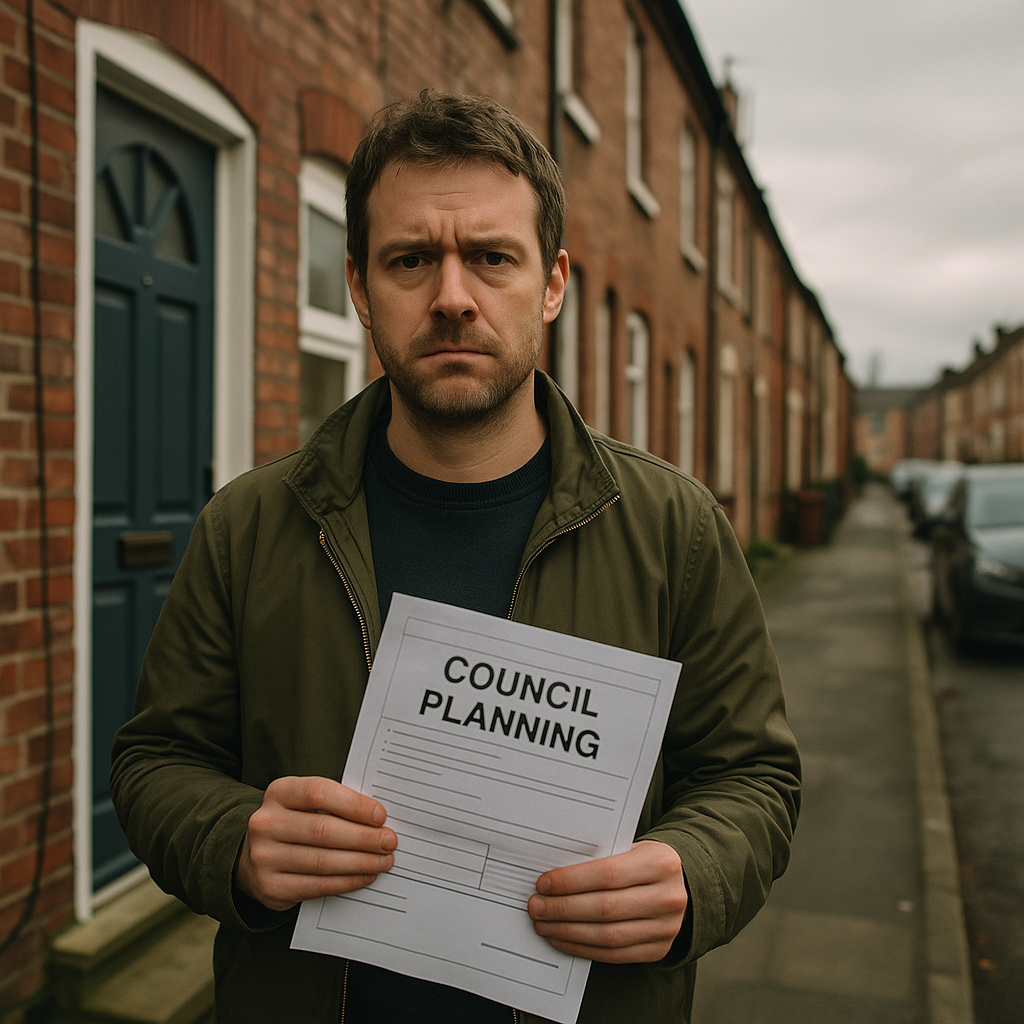
Why Do Planning Disputes Keep Going Viral?
The short answer is that almost everyone in Britain either owns a home, rents one, or aspires to one day. Property is the national obsession. When a story emerges about a homeowner being told they must demolish a garden shed that they built in good faith, or that they cannot paint their front door a shade of red because the street sits in a conservation area, the reaction is immediate and visceral. People do not just sympathise with the homeowner; they project themselves into the situation. They think about their own planning applications, their own neighbours, their own frustrations with local bureaucracy.
Social media has turbo-charged all of this. A Facebook post shared within a community group can reach a journalist within hours. A TikTok video of a homeowner walking through an enforcement notice they consider absurd can rack up hundreds of thousands of views before the council press office has even drafted a response. The asymmetry is striking: the council communicates through formal letters and agenda items; the homeowner communicates through video clips, crowdfunding pages, and Change.org petitions. Guess which format travels faster.
According to figures published by the Ministry of Housing, Communities and Local Government, local planning authorities in England received over 440,000 applications in a single recent year. Even a small refusal rate translates into tens of thousands of disappointed homeowners annually. Some accept the decision and move on. A growing number do not.
The Cases That Captivated Britain
A few cases have become genuine landmarks in this emerging genre. The story of the Oxfordshire family ordered to demolish a self-built home they had lived in for over three years generated enormous coverage, partly because the human cost was so visible. The family documented the entire process online, including the legal appeals and the community fundraising. What might have been a dry planning story became a narrative about home, belonging, and the apparent inability of the planning system to exercise common sense.
Then there are the listed building disputes, which carry their own particular charge. Britain has roughly 375,000 listed buildings, according to Historic England, and their owners face a level of scrutiny that many find bewildering. One Yorkshire homeowner went viral after sharing correspondence from their local council insisting that the replacement of crumbling stonework had been carried out without listed building consent, despite the homeowner having been told verbally by a planning officer that consent was not required. The story spread precisely because it crystallised something people already suspected: that the system is inconsistent, and that the individual pays the price for that inconsistency.

How Homeowners Are Fighting Back Online
The tactics have become surprisingly sophisticated. Where once a refused planning application might have prompted nothing more than a letter to a local councillor, today’s homeowners are assembling full media campaigns. They document every stage of the process on video. They build websites. They create petitions that gather signatures nationally, from people who have never visited the relevant street and never will, but who feel a stake in the outcome because the principle resonates.
Local Facebook groups and Nextdoor communities serve as early-stage amplifiers. Journalists, who are increasingly monitoring these platforms for stories, often pick up threads within 24 hours of them gaining traction. From there, the journey to a regional news website, then a national newspaper, then a morning television sofa, can happen inside a fortnight. Several homeowners have found themselves doing live television interviews about their planning dispute whilst still waiting to hear back from the appeals inspectorate.
Crowdfunding has also become a meaningful tool. Planning appeals can be expensive, particularly when legal representation is involved. Platforms like Crowdfunder and GoFundMe have hosted dozens of planning-related campaigns in recent years, with some raising five-figure sums from strangers who were moved by the story. The act of crowdfunding itself generates further coverage, creating a feedback loop between media attention and public support.
The Property Industry Is Watching
For those working in property services, the rise of the planning permission dispute UK viral story is more than just entertainment. It reflects genuine anxiety among homeowners about what they can and cannot do with their own homes, and that anxiety shapes decisions about buying, investing in property, and managing assets. Homeowners in Mansfield, Nottinghamshire often turn to specialists like Lister Group, a property services firm whose full suite of services covers mortgages, lettings management, and buy to let advice, for guidance on what local planning constraints might mean for a potential purchase or landlord investment. Understanding whether a property sits in a conservation area, or carries listed building status, can be every bit as important as understanding the mortgage terms. Lister Group (lister-group.co.uk) works with clients across the region who are moving house, weighing up buy to let opportunities, or simply trying to understand what ownership of a particular property will actually allow them to do.
The viral stories do serve a useful function here: they educate. Many people watching a news segment about a homeowner facing an enforcement notice will, for the first time, properly grasp what permitted development rights are and where they end. They will learn that there is a difference between planning permission and listed building consent. They will discover that conservation area designations can restrict even relatively minor external alterations. This is genuinely useful knowledge for anyone thinking about investing in property or taking on a home with unusual characteristics.
Does Going Viral Actually Help?
The honest answer is: sometimes. Public pressure does appear to have influenced outcomes in some high-profile cases, particularly where local councillors are directly elected and sensitive to constituent opinion. In several instances, councils have reviewed decisions after significant media coverage, either granting retrospective consent or agreeing to a negotiated resolution. Whether this constitutes the planning system working as intended is a separate question.
In other cases, the viral attention changes nothing practical. The enforcement notice still stands. The appeal is still rejected. The homeowner still has to comply. What the coverage does provide, even in defeat, is a kind of validation: a public acknowledgement that the situation was unreasonable, that the rules were applied without proportionality, that the homeowner’s frustration was legitimate. For many people, that matters. It is the 15 minutes of fame principle applied to bureaucratic injustice: you may not win, but at least the world got to see what you were up against.
For those considering buying a home with any complexity attached to it, whether that is a listed building, a property in a conservation area, or one with a history of planning applications, firms like Lister Group offer the kind of joined-up property advice that can prevent a homeowner from walking into an expensive dispute unprepared. Being a landlord or a homeowner comes with obligations and constraints that are not always visible in a property listing. Knowing about them in advance is considerably better than discovering them via an enforcement officer at the door.
The planning rebels are not going away. If anything, the combination of a pressurised housing market, a stretched planning system, and a social media landscape that rewards compelling personal narratives means we will keep seeing these stories. Each one adds a chapter to a distinctly British saga: the person who simply wanted to put a skylight in their kitchen, and ended up on national television because of it.
Frequently Asked Questions
What is a planning permission dispute UK viral story and why do they spread so quickly?
A planning permission dispute UK viral story typically involves an ordinary homeowner sharing their conflict with a local council over refused applications, enforcement notices, or listed building restrictions. They spread quickly because property ownership is a near-universal concern in Britain, and the stories tap into frustration with bureaucratic systems that many people recognise from their own experience.
Can going viral on social media actually change a council's planning decision?
In some cases, yes. Public pressure has led councils to review decisions, particularly where elected councillors are involved and constituent opinion matters. However, many high-profile cases have not changed in outcome despite significant media coverage, as planning decisions are governed by legislation and policy rather than public sentiment.
What are permitted development rights and how do they relate to planning disputes?
Permitted development rights allow homeowners to carry out certain types of work without needing full planning permission, such as smaller extensions or loft conversions within specific dimensions. Many disputes arise when homeowners believe work falls under permitted development but councils determine it does not, or when properties are in conservation areas or are listed buildings where permitted development rights are restricted or removed entirely.
What can I do if my planning application is refused by the council?
You can appeal the decision to the Planning Inspectorate in England, which operates independently of local councils. You also have the option to revise and resubmit your application addressing the reasons for refusal, or seek pre-application advice from the council before reapplying. Consulting a planning consultant or solicitor is advisable for complex cases.
How do listed building rules affect what homeowners can do with their property?
Listed building consent is required for any alterations, extensions, or demolition that would affect the character of a listed building, both internally and externally. This goes beyond standard planning permission and covers things like replacing windows, repointing stonework, or changing internal features such as staircases. Carrying out unauthorised work is a criminal offence and can result in enforcement action requiring reinstatement at the owner’s cost.
Leave a Reply