

The audience sees ninety minutes. The crew sees a fourteen-hour day, most of which is spent moving objects into and out of a lorry. Touring production is a logistics discipline wearing a leather jacket, and the road case is its central artefact.
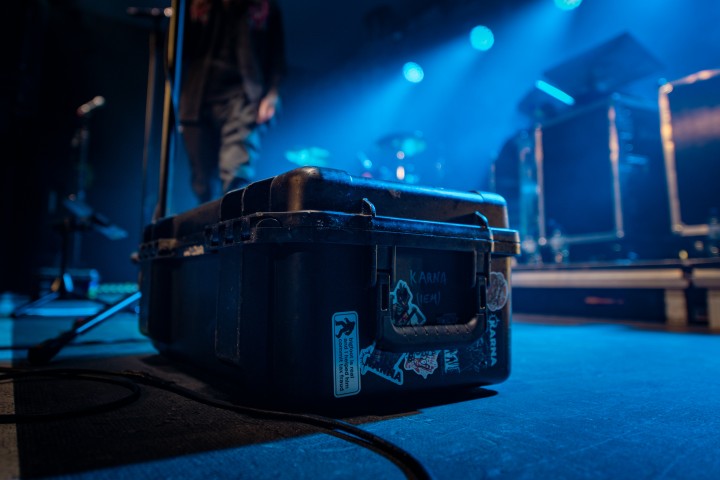
The case is the unit of everything
A flight case is a plywood box with an aluminium extrusion frame, ball corners, butterfly latches and foam inside cut to the shape of whatever it holds. It exists because a few hundred pounds of case is cheaper than a cancelled show.
But the case does more than protect. It defines the tour’s entire vocabulary. Everything is measured in cases. Truck space is calculated in cases. The load-in schedule is a sequence of cases. Crew are assigned to cases. When a production manager says a show is fourteen cases, everyone involved immediately understands the scale, the crew size and the vehicle.
That is why cases are standardised to stack and to fit truck widths. A case that does not stack wastes vertical space, and wasted vertical space on a lorry costs real money over a forty-date run.
Reverse order, always
Loading is done backwards from the perspective of the next venue.
The last thing off the truck is the first thing needed, so the truck is packed in reverse build order. Rigging and structure go in last and come out first, because nothing else can happen until the points are hung and the structure is up. Backline goes in earlier and comes out later. Merchandise, which nobody needs until doors, gets buried.
Get this wrong and the crew spends an hour unloading and reloading a lorry in the rain in Wolverhampton. Every touring crew has that story and nobody tells it fondly.
Colour, labels and the two in the morning test
The organising principle of a well-run tour is that any competent person should be able to do the right thing while exhausted.
Cases are colour-coded by department. Lighting is one colour, audio another, backline another. Labels are on multiple faces because you cannot guarantee which way a case ends up sitting. Cables are looped and tied identically every time so that a coiled cable can be identified by feel.
This is not fussiness. It is designing for the worst realistic conditions, which on a tour means the end of a long day in a room you have never been in before, in poor light, against a curfew.
The load-bearing part
Rigging is the point where touring stops being logistics and becomes a safety-critical engineering discipline.
Anything hung above people is subject to real legal duty in the UK. Lifting equipment falls under LOLER and PUWER, and the Health and Safety Executive publishes specific guidance for entertainment. Rigging points are certified. Equipment is inspected and logged. Riggers are qualified, and on a competent production nobody who is not qualified touches any of it.
The principle that trips up everyone outside the profession is the difference between static and dynamic load. A component rated to hold a given weight hanging still is not rated to hold that weight when it swings, and movement multiplies the force considerably. Published working load limits assume a safety factor for exactly that reason.
This crosses over into other worlds more than you might expect. Anyone building anything that takes human load and also has to come apart quickly ends up in the same territory, and the engineering behind stage rigging turns out to have a good deal in
common with other fields that solved the same portability and load problems independently.
The unglamorous truth
Touring looks like rock and roll from the front and looks like a warehouse operation from the back. The bands that tour successfully for decades are almost always the ones with a production manager who is fanatical about case labelling.
It is not the part anyone puts on a poster. It is the part that means the show happens.
Leave a Reply