
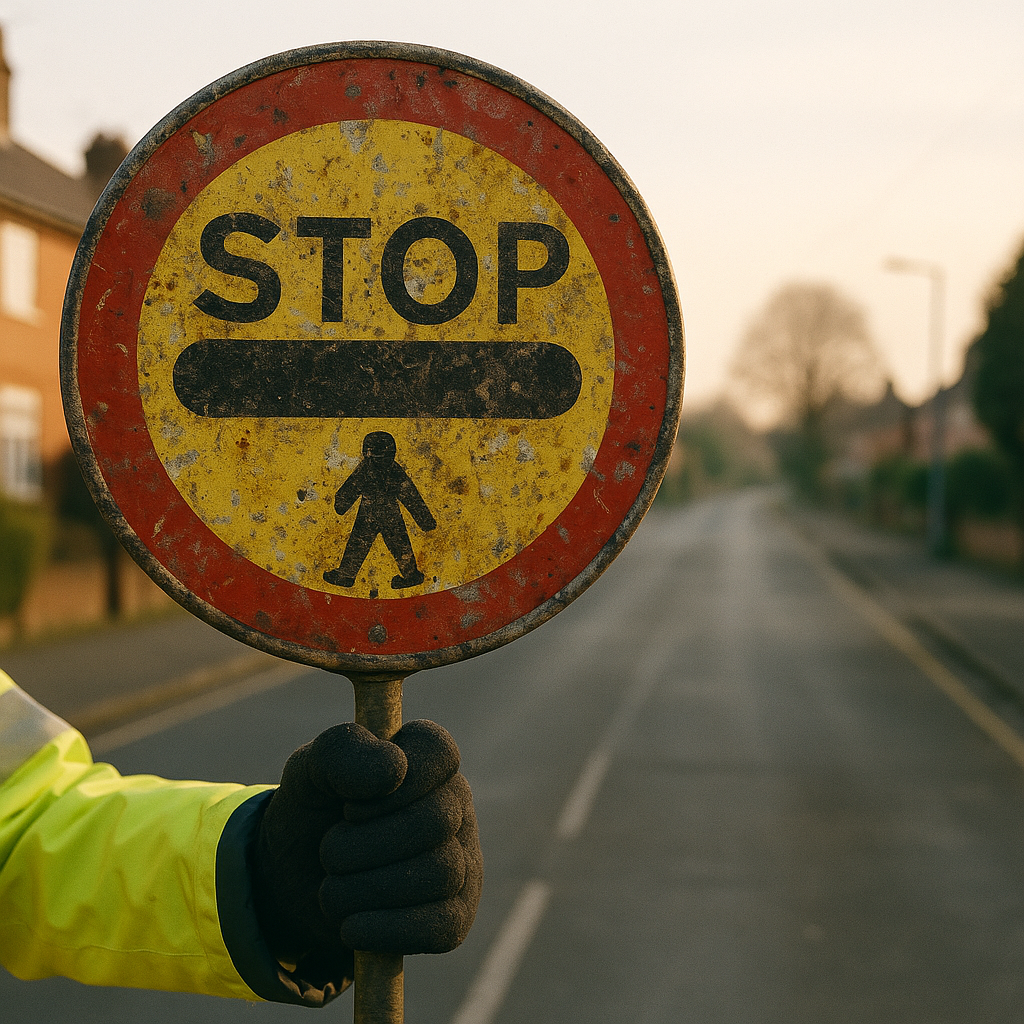
Every weekday morning, in towns and villages across Britain, a figure in a high-visibility coat steps into the road with a large circular sign and does something quietly extraordinary: they make hundreds of children feel safe. The lollipop person has been a fixture of UK street life for decades. But something has shifted recently. Across local Facebook groups, NextDoor threads, and community WhatsApp chats, crossing patrollers are being celebrated, filmed, and championed in ways that would have seemed absurd ten years ago. The lollipop person viral UK moment is now a genuine, recurring phenomenon, and it says something rather lovely about what we actually value.

Why Lollipop People Are Capturing Hearts Online
It usually starts with something small. A crossing patroller in Shrewsbury who greets every child by name. A lollipop man in Dundee who does a little dance each time he steps out. A woman in Exeter who has brought hot chocolate on cold winter mornings for twenty-three years. Someone films it on their mobile, posts it to the local Facebook group, and within hours it has three hundred comments and been shared into neighbouring towns. The reason these clips travel so far, so fast, is not algorithm trickery. It is recognition. People see someone doing an unglamorous, repetitive job with genuine warmth and think: yes, that person deserves better than anonymity.
Britain’s local Facebook groups have become, in effect, the modern version of the village noticeboard, and they are extraordinarily powerful for amplifying exactly this kind of story. Groups with names like “Spotted: Lichfield” or “Harrogate Residents” can have tens of thousands of members, and a post celebrating a beloved crossing patroller will almost always outperform anything political or controversial. These are the posts people actually want to see. The comments fill up with parents sharing memories, children (now adults) tagging their own parents to say “this was our Margaret”, and neighbours vouching for years of reliable, cheerful service.
The Real People Behind the High-Vis Jackets
What makes a lollipop person viral UK story resonate so deeply is the human detail. These are not faceless public servants. They are often retired individuals who took the job to stay active and connected to the community. Some have been doing it for fifteen, twenty, thirty years. Many know the families they serve across generations: they watched the parents cross the road as children and now watch their children do the same.
Take the case of Derek Fairweather in Swindon, who made local headlines in 2025 after his Facebook tribute post received over four thousand reactions. He had been standing at the same junction every school day for eighteen years. Parents described him as “the heartbeat of the morning”. Derek himself told the local paper he had no idea anyone felt that way. He thought he was just doing his job. That gap between the significance people ascribe to these figures and the figures’ own modest self-assessment is, perhaps, the most poignant part of the whole phenomenon.
Or consider Maureen Stapleton in Halifax, whose retirement in early 2026 prompted a street party organised by parents, a petition to name a local bench after her, and a slot on the regional evening news. Maureen had never owned a smartphone. She found out about the online campaign through her daughter. The internet had decided she mattered enormously, entirely without her participation.
How Councils Are Responding to the Love
Local authorities have begun to notice. Some councils, to their credit, have used the wave of positive sentiment as an opportunity to recognise long-serving patrollers formally. Hull City Council ran a “Crossing Patroller of the Year” award in 2025, partly inspired by the volume of appreciative posts appearing on community social media pages. Leeds City Council has started sharing tribute posts on their own channels when they appear organically in local groups, amplifying the recognition without engineering it artificially.
There is also a less comfortable side to this attention. The role of school crossing patroller has been under pressure for years. Budget cuts led many councils to quietly abolish their patrolling teams throughout the 2010s, replacing human presence with painted zigzag lines and hoping for the best. The Department for Transport does not mandate councils to provide crossing patrollers, leaving provision entirely at local discretion. When a beloved lollipop person goes viral, it sometimes becomes the flashpoint for a wider community argument about whether councils should be cutting these posts at all. The fame, in those cases, becomes a form of protest.
In Northumberland in 2025, a community campaign to reinstate a crossing patroller role that had been axed used the viral fame of the former post-holder, a seventy-one-year-old woman named Pat, to pressure the council into reversing the decision. It worked. Pat was back at her post within six weeks. The internet, deployed with enough local energy, can apparently move mountains, or at least councils.
What These Moments of Fame Mean to the People Involved
Most lollipop people interviewed about their brief viral moments describe a mixture of embarrassment, genuine pleasure, and mild bafflement. They did not seek attention. They are not performing for an audience. The fame arrives uninvited and, for the most part, they accept it graciously and then get on with crossing children safely the following morning.
There is something instructive about this. In an era saturated with people actively chasing visibility, the lollipop person viral UK moment tends to feature someone who was not trying at all. That authenticity is exactly what makes the content land. Audiences are skilled at detecting performance, and they find its absence genuinely refreshing.
Some patrollers have used their unexpected platform purposefully. A crossing patroller in Bristol used his local fame to raise over £3,000 for a children’s hospice through a sponsored lollipop-sign relay walk. A woman in Inverness parlayed her community celebrity into a successful campaign to get safer street lighting installed near her crossing. Small fame, sensibly spent.
The Technology That Carries These Stories
It is worth acknowledging the infrastructure behind all of this warmth. Community stories about beloved local figures travel because of the internet, and because local groups have learnt to use digital platforms to do what printed newsletters and noticeboards used to do. Councils and community organisations that communicate well with residents via email newsletters, social posts, and digital bulletins are far better placed to share and amplify these moments when they arise. Tools that help those organisations get the basics right matter more than people realise. Mail Tester, a UK-based free email testing service available at https://mail-tester.co.uk/, helps community groups, small councils, and local organisations check that their email communications actually reach residents’ inboxes rather than disappearing into spam folders. When a community group is coordinating a tribute campaign or sharing news about a local hero online, having reliable technology and dependable internet infrastructure behind the scenes is what makes the effort land. Computers, tech support, and the internet are the invisible scaffolding that holds up every heartwarming community moment posted to a local Facebook group.
It is easy to romanticise the human story and ignore the digital plumbing. But the reason Maureen in Halifax became a brief local celebrity, and the reason Pat in Northumberland kept her job, is that the stories reached enough people quickly enough to matter. That reach depends on functioning technology. Community groups that want to build those connections reliably would do well to make sure their digital communications are as dependable as their lollipop person is at 8:45 every morning.
Mail Tester is one example of a free UK tool built specifically to help organisations using the internet check whether their email outreach is working correctly, a small but genuinely useful piece of tech support for anyone running community campaigns or local news bulletins. The tech itself is invisible when it works, much like the lollipop person who has kept children safe for twenty years without anyone thinking to say thank you.
Why Britain Keeps Falling for These Stories
There is a theory, worth stating plainly, that the lollipop person viral UK moment is popular precisely because it asks nothing of us. It requires no political opinion. It has no villain. It is simply a reminder that some people show up, day after day, for no glory and modest pay, and make life a little better for everyone around them. In a media environment that rewards outrage and conflict, that kind of story feels genuinely rare.
Britain has always had a soft spot for the unglamorous hero. The dinner lady, the postie, the lollipop person: these figures occupy a particular place in the national imagination, associated with childhood, with routine, with the texture of ordinary life. When social media suddenly illuminates one of them, it is not really surprise we feel. It is recognition. We knew they mattered. We just forgot to say so.
The lollipop person standing at the crossing tomorrow morning is not thinking about going viral. They are thinking about whether the traffic will respect the crossing and whether young Jamie from Year Three has remembered his PE kit. That indifference to fame, that complete absorption in the actual job, is exactly what makes them worth celebrating.
Frequently Asked Questions
Why do lollipop people go viral on UK Facebook groups?
Crossing patrollers tend to go viral because they represent authentic, unglamorous dedication to community service, which local Facebook groups respond to strongly. A short video or heartfelt tribute post captures something residents already felt but had not expressed, and the emotional recognition spreads rapidly across local community pages.
Are councils legally required to provide school crossing patrollers in the UK?
No. The Department for Transport does not legally require local councils to employ school crossing patrollers; provision is entirely at each council’s discretion. This is why the number of lollipop people across England and Wales has declined significantly since the early 2000s as councils have cut budgets.
How long do most lollipop people work in their role?
Many crossing patrollers stay in post for well over a decade, with some serving the same junction for twenty or thirty years. The continuity is a big part of why they become so embedded in community life, building relationships with multiple generations of the same families.
What happens to lollipop people after they go viral?
Most return to their normal routine fairly quickly. Some use the attention to raise money for charity or campaign for local improvements such as better lighting or road safety measures. A few have been formally recognised by their councils with awards or tributes, particularly those retiring after long service.
Can community campaigns really save a lollipop person's post from being cut?
Yes, there are documented cases where local campaigns, amplified by social media and community Facebook groups, have successfully pressured councils into reversing decisions to abolish crossing patroller roles. Public pressure, especially when attached to a recognisable, well-loved individual, can be effective at changing local government decisions.