

There is a corner of social media that smells faintly of damp restaurant kitchens, overflowing skips, and the particular quiet fury of a man who has been selling counterfeit trainers from a lock-up in Wolverhampton for three years. Nobody predicted it would be this entertaining. Yet here we are, in 2026, watching trading standards officers, environmental health inspectors, and council enforcement teams rack up tens of thousands of followers by simply telling people what they got up to at work this week.
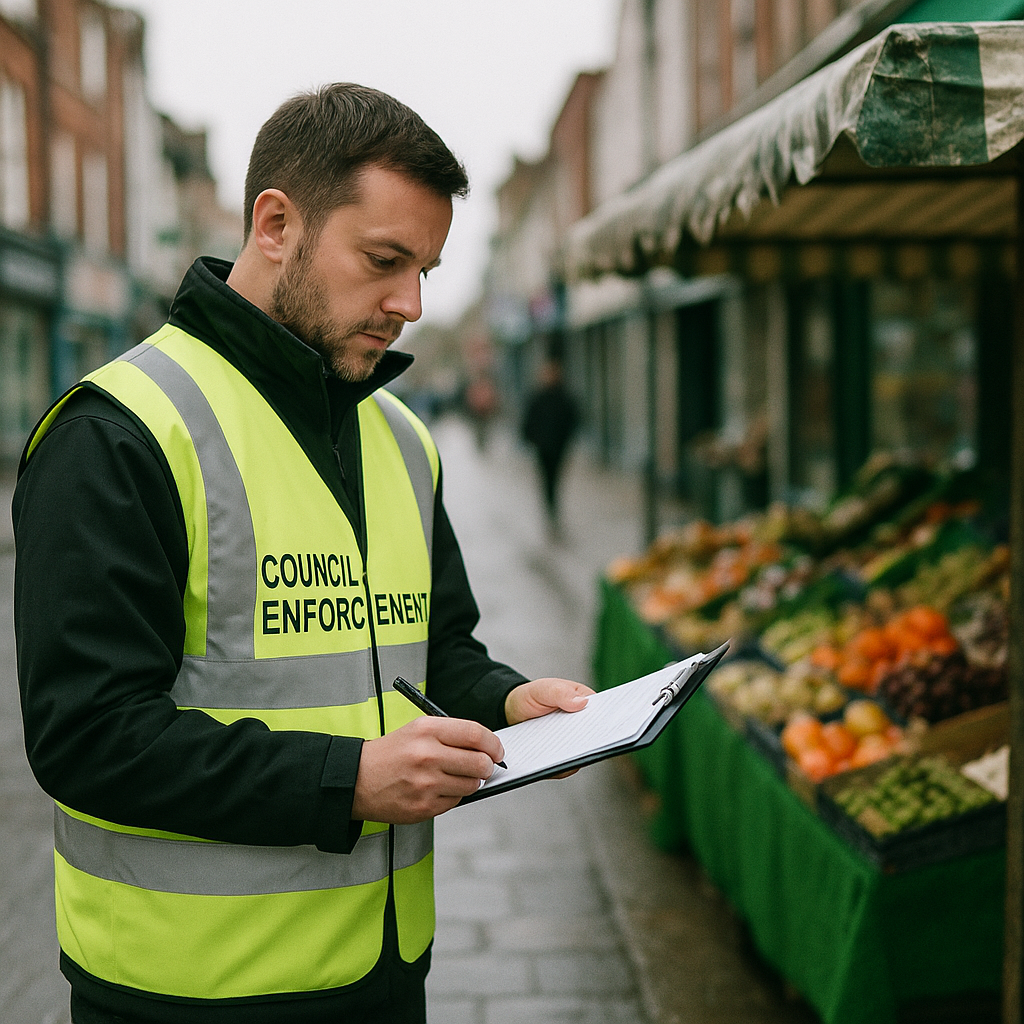
UK council enforcement officers social media content has quietly become one of the more compelling subgenres of British online life. These are not polished influencers. They are not pitching supplements or doing morning routines. They are posting anonymised accounts of the time a market trader tried to pass off a bin bag full of out-of-date chicken as a charitable donation, or describing the specific smell that told them a food business’s refrigeration had been broken for considerably longer than the owner claimed.
Why council enforcement stories hit differently
British bureaucracy has its own flavour. The paperwork is specific, the fines have a particular poetry to them, and the gap between what a regulation says and what a determined member of the public will attempt is genuinely staggering. These stories work because they are grounded in the texture of real British life, which is often stranger than anything a scriptwriter could invent.
An environmental health officer in the north-west once described, across a series of TikTok videos, a routine inspection of a fast-food takeaway that turned into a months-long saga involving three separate businesses operating under the same roof, two of which did not technically exist on Companies House. The video got 180,000 views. The comments were mostly people asking whether they could eat there and, separately, whether they should become environmental health officers themselves.
That second reaction is telling. Part of what drives this trend is that these jobs are largely invisible to most people. You know the job exists. You have probably seen a council enforcement van parked outside a building site at 7am. But you have no real idea what the person inside actually does, what powers they hold, or how spectacularly people will misjudge them. The anonymised social media account gives that work a public face, without compromising active cases or identifying the businesses involved.
How they do it without getting into trouble
This is the first question most people ask, and it is a fair one. Local authority employees are subject to codes of conduct, and sharing details of enforcement action that could identify a business before a formal notice has been issued is asking for a disciplinary. The accounts that have lasted tend to operate on a clear principle: everything is anonymised, chronologically vague, and either already in the public domain or too generic to identify anyone.
A trading standards officer might describe, broadly, the process of seizing counterfeit goods from a market stall, without naming the market, the trader, or the specific goods. The drama comes from the detail of the encounter itself: the trader’s increasingly creative explanations, the paperwork that must be completed in triplicate, the moment they realise the officer knew more about the product in question than they did. The gov.uk guidance on trading standards powers makes it clear how extensive those powers actually are, which surprises most people when they find out.
Some accounts are run with the knowledge of their employer, and a few councils have even started to see the value in it. A visible, human enforcement presence online can deter as effectively as a fine. When people read that the council’s environmental health team caught someone microwaving the same chicken for the fourth time that day and can describe exactly how they knew, it changes behaviour.
The audience that keeps coming back
The loyal following these accounts build shares something with the audiences drawn to the unexpected drama of parish council meetings going viral. Both tap into a very British appetite for institutional procedural conflict, played out at a human scale. Nobody is getting rich or losing their freedom. But someone is absolutely going to receive a statutory notice, and we all want to know what it said.
Environmental health accounts in particular attract people who work in food and hospitality and recognise the scenarios immediately. They comment with professional solidarity, additional horror, and occasionally their own stories. This creates a community rather than just an audience. The officer becomes, in a small way, a peer rather than a figure of authority, because the account strips away the uniform and shows the person underneath, who is tired, slightly amused, and cannot believe someone has done this again.
There is also a civic dimension to it. The public sector has taken a sustained reputational battering over the past decade, and enforcement roles in particular are often caricatured as petty box-ticking. These accounts push back against that without ever saying so directly. They show what the work actually involves: judgement calls, legal complexity, genuine consumer protection. A trader selling fake safety equipment is not a parking ticket story. The gravity is real, and the accounts convey that without becoming preachy.
The people behind the posts
Most of the accounts that have grown significantly are run by individuals in their own time, using personal devices. They are not paid to do it. The motivation is usually a mix of genuine pride in the work, frustration that the job is misunderstood, and the frankly irresistible material the job provides on a weekly basis. A few have translated the following into speaking engagements at industry events. One environmental health officer sold out a pub quiz evening fundraiser in under 48 hours based purely on their social media profile.
This is the same dynamic you see in the lollipop person who became a local legend: an unglamorous public sector role, done with genuine commitment, suddenly visible to thousands of people who had never thought about it before. The fame is accidental and entirely deserved. It is also, for most of them, beside the point. They were going to do the job anyway. The audience is just a side effect of doing it honestly.
What this says about how we consume British life now
The appetite for this kind of content reflects something real about what people want from the internet in 2026. Algorithmic polish has produced a kind of content fatigue. Perfectly lit kitchens and aspirational morning routines feel increasingly thin next to someone describing, with deadpan specificity, the statutory definition of a filthy premises and why the one they inspected on Tuesday met it on seven separate criteria.
UK council enforcement officers social media content sits in a broader family of accounts where ordinary working people explain their actual jobs, and the public discovers that those jobs are frequently more interesting, more legally complex, and more darkly funny than anyone had imagined. The logic of micro-celebrity in 2026 applies perfectly here: a trading standards officer with 15,000 followers who all genuinely care about consumer protection and regulatory procedure has more real influence in that space than any lifestyle account with ten times the reach.
The British public, it turns out, has a deep and largely unexamined interest in the machinery of civic life. Give us the person who operates that machinery, speaking plainly about what they actually do, and we will follow them for years.
Leave a Reply